
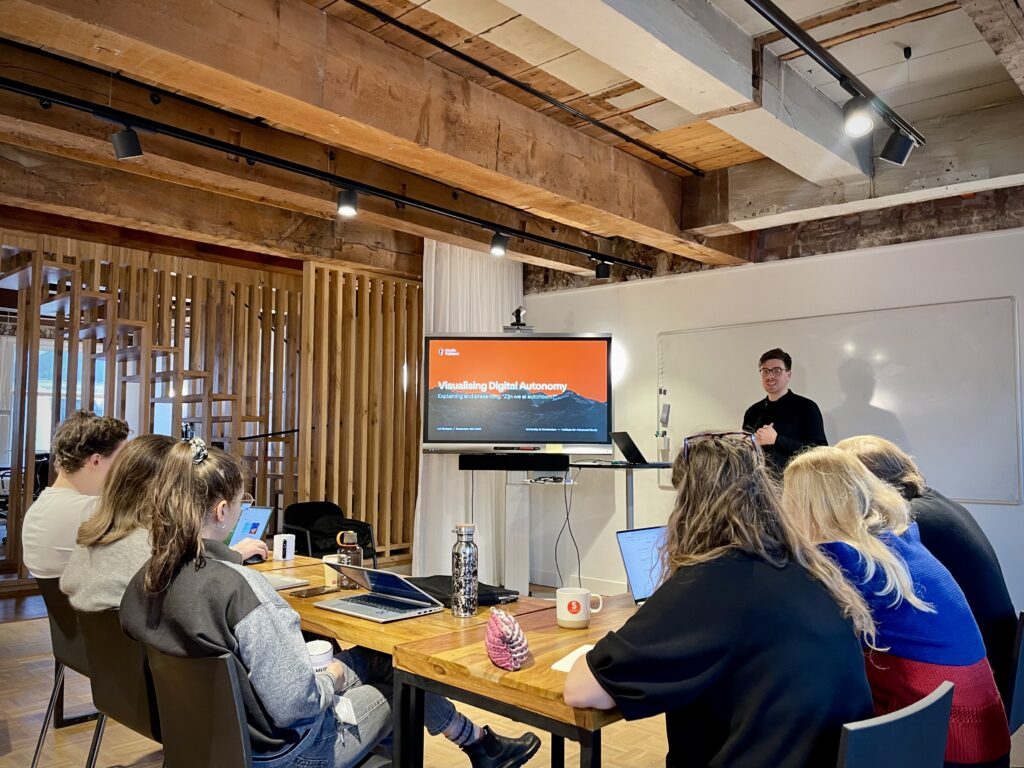
Recently, Lei Nelissen from Studio Falkland paid a visit to our lab to showcase their online data visualizer of the current state of Dutch digital autonomy, “Zijn we al autonoom?” (Are we autonomous yet?). As the AI, Media & Democracy Lab is also currently focusing efforts on mapping infrastructural dependencies on Big Tech and American companies, fruitful conversations took place about what can be done to maintain tech sovereignty.
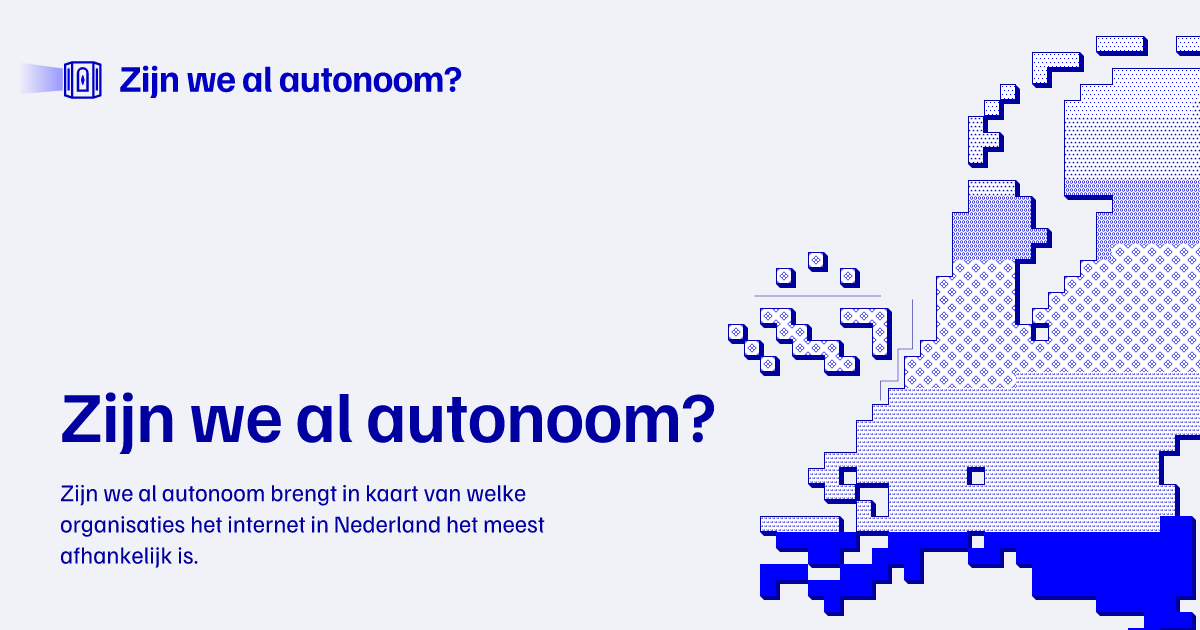
The importance of finding European alternatives to the main services we all use daily becomes apparent with a glance at the visualizer: a large proportion of e-mail services, collaborative software and web hosting services are supplied by US companies like Microsoft, Google, and Amazon. It shows that many core sectors in the Netherlands (especially governance, healthcare, and education) are largely technologically dependent on the USA.
To alleviate this issue, initiatives like European Alternatives are collecting and classifying substitutes to digital services and products that are developed in Europe. Many individuals are also undergoing the process of “de-Googling” their online workspaces. Efforts are ongoing, but they also need to become more widely coordinated. Citizens who are deciding to lower their individual reliance on Big Tech should receive support from the institutions in their daily life, like workplaces, schools, and government agencies. This is why decisions like the the one taken by the University of Amsterdam to actually support alternatives to Microsoft services on its institution-wide ICT infrastructure are the most important steps we can take towards a fully digitally autonomous future.
