
What are media organizations currently doing with AI agents? What challenges and opportunities do AI agents bring to journalism?
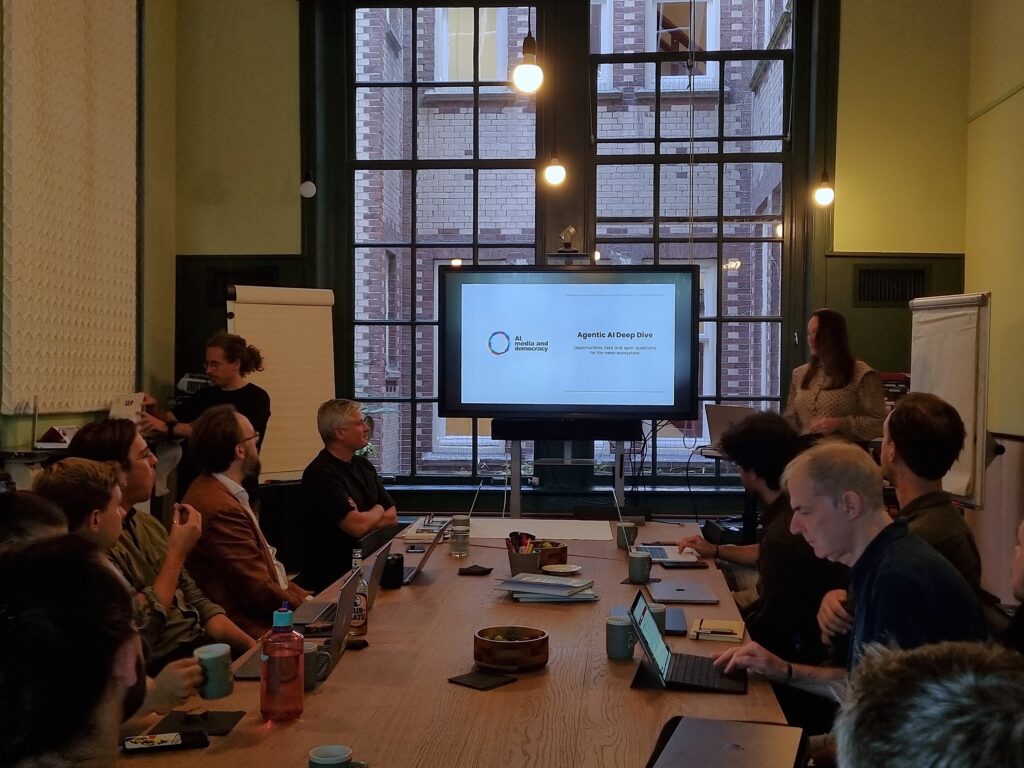
Guillermo Romero Moreno, Marcio Fückner and Merel Noorman from our Lab recently held a workshop where we invited journalists engaged in a diversity of types of news production — public broadcasting, local investigative work, freelance, and more —to discuss their views on AI agents with our researchers. The goals were to map current practices in the industry, create shared vocabulary on the responsible use of AI, and find research questions that might warrant further exploration or collaboration.
Common ground was first established by Marcio, who presented an overview of the history and current basic principles of LLM agents, the control that human developers and users have over them, and how multi-agent systems coordinate and divide tasks. Given how “agentic” has become such a buzzword in the tech world, it was important to go over how an agentic AI system is defined, either through its architecture (i.e. being comprised of multiple AI agents that can plan and execute tasks or set goals with minimal human supervision) or its behavior (its agency lies in how specific — or vague — instructions are; the less specificity, the more room for agency).
Researchers and journalists then shared some specific findings and insights from their perspectives on the practicalities of introducing AI agents at various steps of the news production process, from research, documentation, fact checking, monitoring of topics on the public agenda, to the actual writing and editing of final content for publication. A strong point made by the researchers in the room was that despite their name, the behavior of agents is sensitive to how they are constructed and to the design decisions taken by their human developers, especially in terms of assigning them roles and identities.
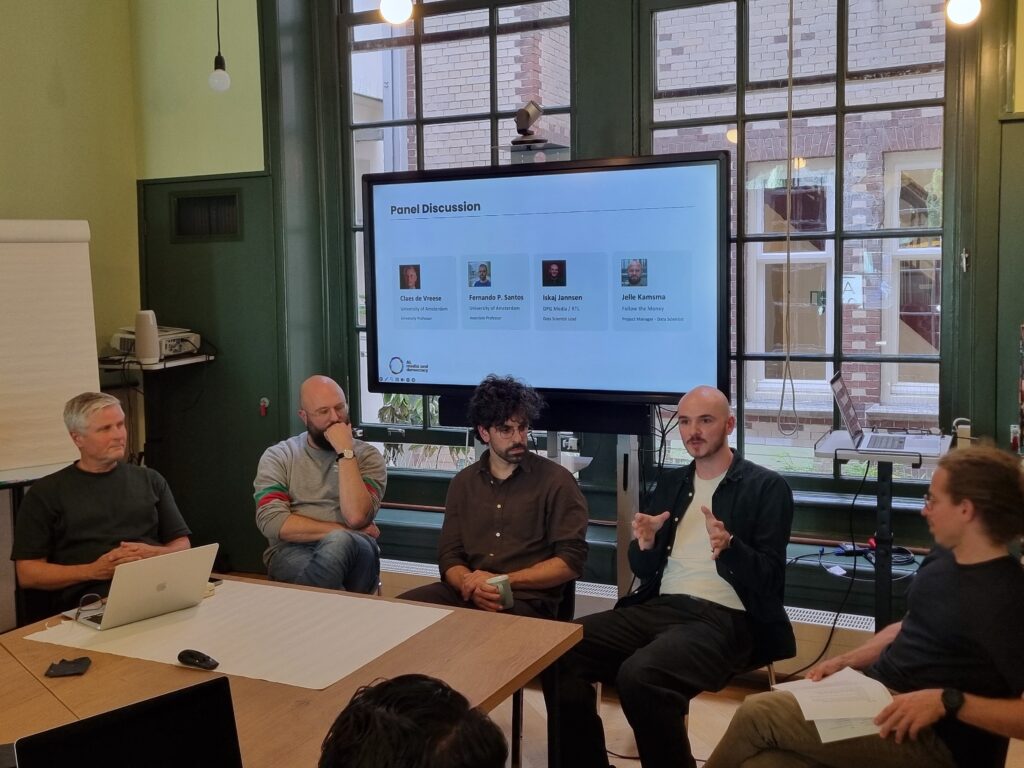
On the other hand, the problems raised by the journalists concerned a latter part in this process: ensuring transparency and proper verification output. As the ethical and moral basis of the profession implies open and transparent investigation and reporting, if journalists begin delegating parts of their workflows to AI, they need to have a complete understanding of exactly what agents are doing, how they are completing tasks, and most crucially, strong limits need to be established that are reliably respected. These requirements come into conflict with the general purpose of agentic AI, of lowering the effort expenditure needed for constant human oversight — thus, ideas and solutions are needed to strike a balance between the need to remain competitive and up-to-date in publishing news, while also being fully accountable for the entire creation process even if some parts may have been outsourced. Participants explicitly shared that, especially when verifying information, journalists would not be willing to take responsibility for results from an agent with 99% confidence or accuracy; complete confidence and reliability is needed, while journalists may also suffer from verification fatigue.
Another issue that was brought up concerns the use of AI agents from the readers’ side, for news search, curation and consumption or summarization. The effects of this phenomenon are something we are already studying in our project Digital Autonomy that Fits, in partnership with de Correspondent and Follow the Money, representatives of which were also present for this afternoon. Due to the involvement of AI systems in between readers and news providers, organizations are losing traffic and revenue, and are no longer able to reliably distinguish between clicks made by a human or by an agent. Furthermore, how do we account for bias or fairness in the sources of information used by the AI?
Towards the end of the workshop, we split into groups to discuss practical problems of agentic systems in journalism in greater detail, in terms of issues of news consumption, as well as what this means for democracy and accountability. This part yielded the clearest open questions and takeaways: how can journalists verify what agents did? Or what they didn’t do, or didn’t find? Agents can be very helpful, for both consumers and producers of news, but how do we avoid putting too much trust in them? How do we anticipate and mitigate the ways in which they may disrupt business models or lead to lower quality content? How do we regulate their use?
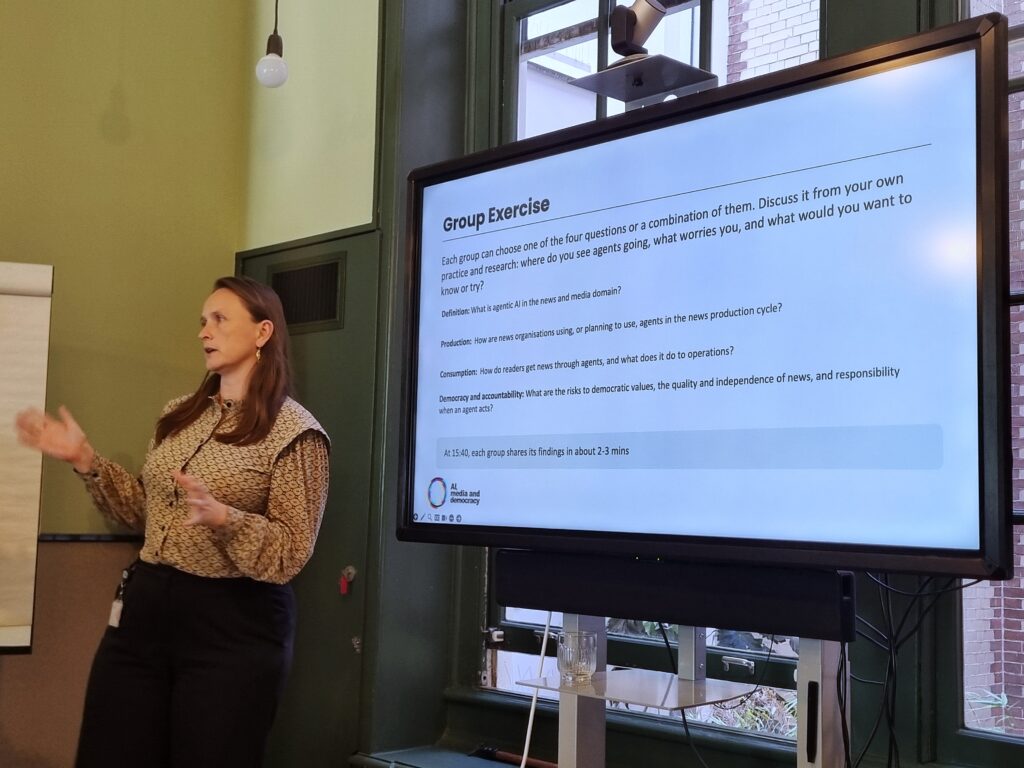

The conversation moved from what agents are technically equipped to do, to what journalists can responsibly delegate; this might be a useful direction for the broader narrative of discussions in this domain as well. Across the afternoon, verification, traceability, editorial independence and audience relationships repeatedly complicated the promise of automation. A good starting point for integrating agentic systems is therefore not simply automating crucial processes in the newsroom, but investigating where assistance adds value, where human judgement must remain, and how that boundary can be made visible. After all, in a world where the amount of unreliable content is increasing due to AI, the role of journalism in providing quality information is more important than ever.
