
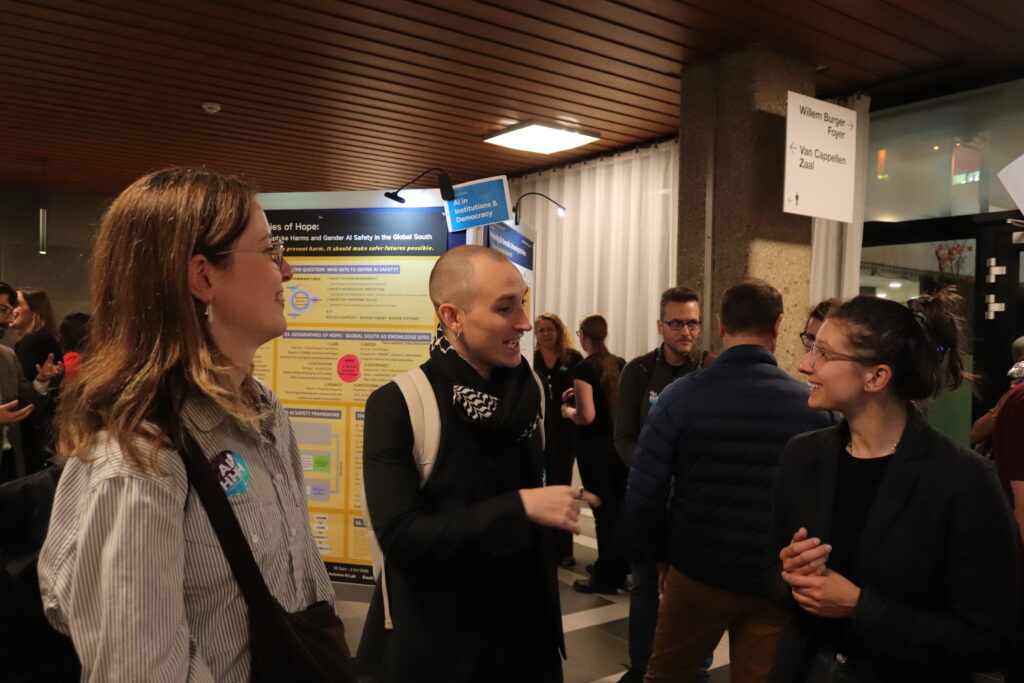
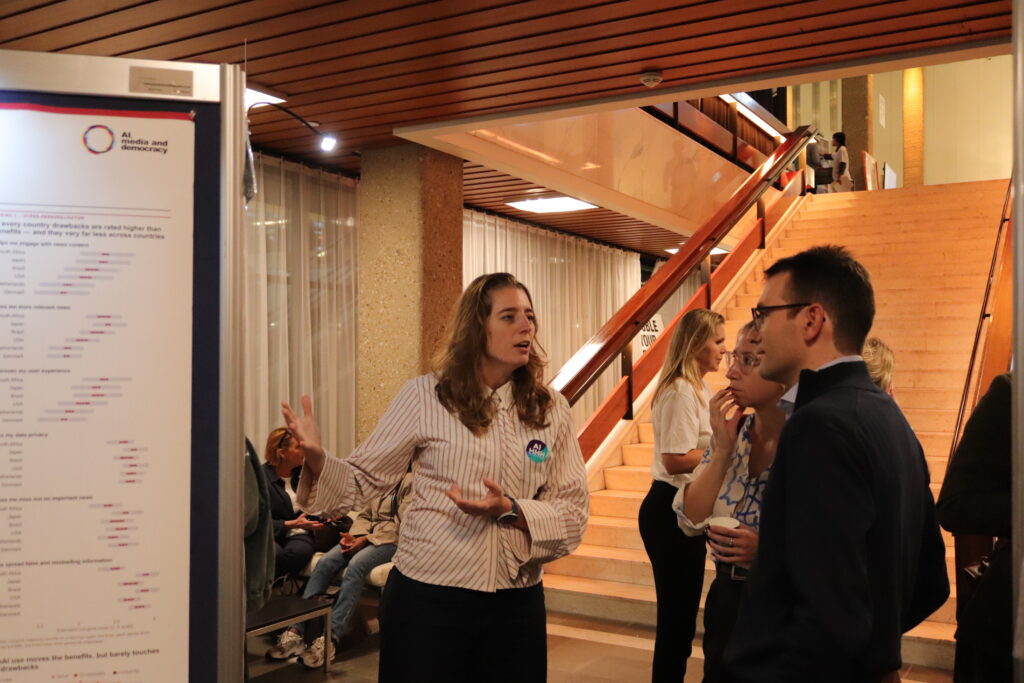
AI Hype, Hope and Humanity, the conference-turned-festival organized by the network of ELSA Labs in the Netherlands, has just taken place in Rotterdam, and our Lab is here to report back! We were richly represented by our members with posters, talks, and even a panel featuring researchers and an industry professional discussing current pressing issues related to AI in the media.
A common impression our members were left with was the positive surprise of seeing all the academic aspects of a conference become intertwined with the activities of the very societal stakeholders involved in much of the research being presented. Among posters and talks were also tech demos from local developers, arts and crafts workshops, book exchanges, a startup competition, and a lively visit from several local primary schools. It seems that the goal of openly discussing and negotiating responsible AI across disciplinary and institutional boundaries was well achieved!


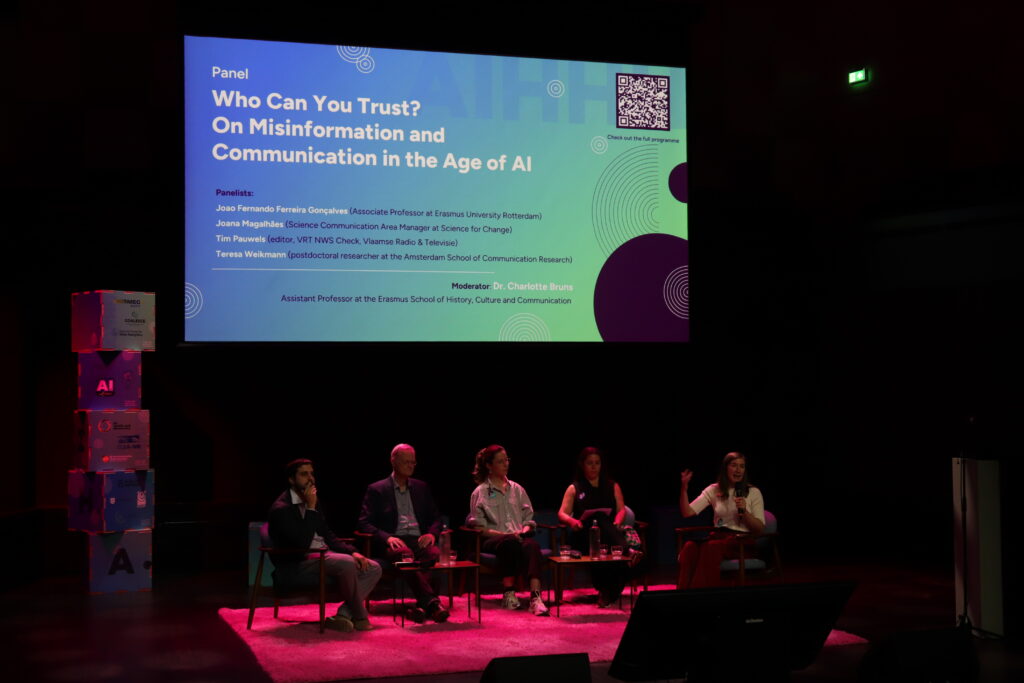
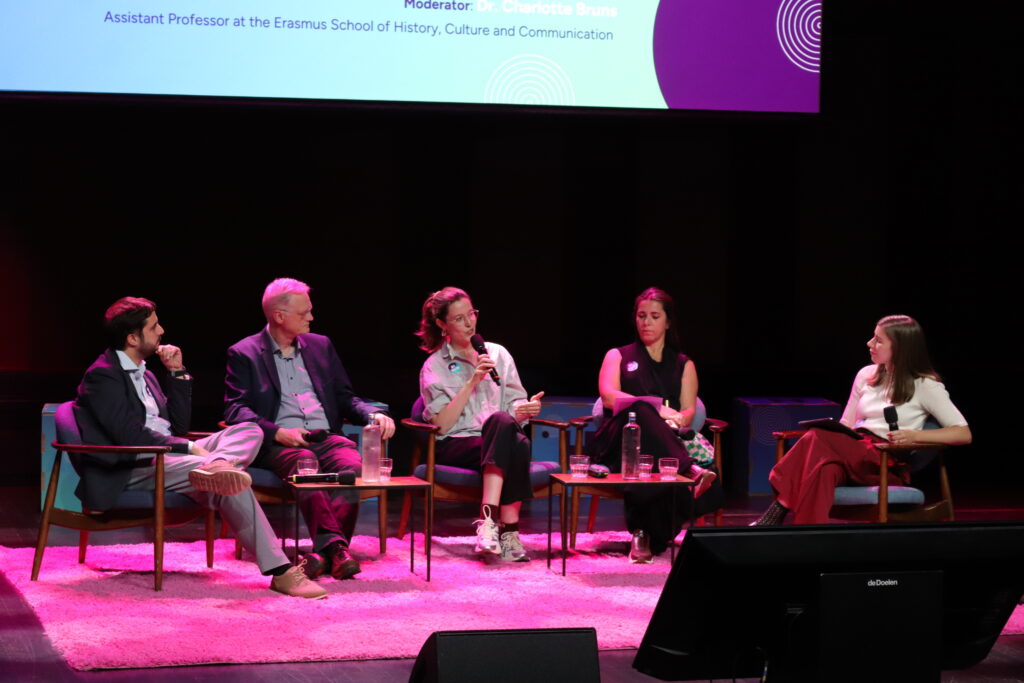
Our highlight from the program is the panel “Who Can You Trust? On Misinformation and Communication in the Age of AI”, jointly hosted by COALESCE and our Lab, discussing the challenges that both researchers and journalists have to face in establishing norms of truth. The panel featured dr. Joana Magalhães (with a background in molecular biology and regenerative medicine, now specialized in science communication), dr. João Gonçalves (who has technical expertise in online hate speech, algorithmic discrimination, and LLMs), our postdoctoral researcher Teresa Weikmann (specialized in visual disinformation), as well as Tim Pauwels (editor at VRT NWS Check and co-founder of Factcheck Vlaanderen).
The starting point of discussion was the fact that technical barriers to creating convincing false content have been lowered with the advent of AI. Panelists agreed that when mitigating the effects of this content, rather than placing the burden on readers to discern the factuality of end-products they’re receiving, a better and more effective approach would demand coordinated action from platforms, AI developers, and governments to implement accountability measures (such as more precise legislation, or fines). From a science communication perspective, the future seems to be in shifting from one-way dissemination to more participatory approaches that more directly involve audiences and strengthen community resilience. A point brought in by the audience also highlighted that a critical gap exists between public concerns (focused on deepfakes or textual misinformation with LLMs) and regulatory priorities under the EU AI Act (which only specifically regulates high-risk systems, leaving LLMs only with guidelines). This suggests that public trust in institutions and clear communication about how AI actually works may be more valuable than technical fixes alone in countering misinformation.
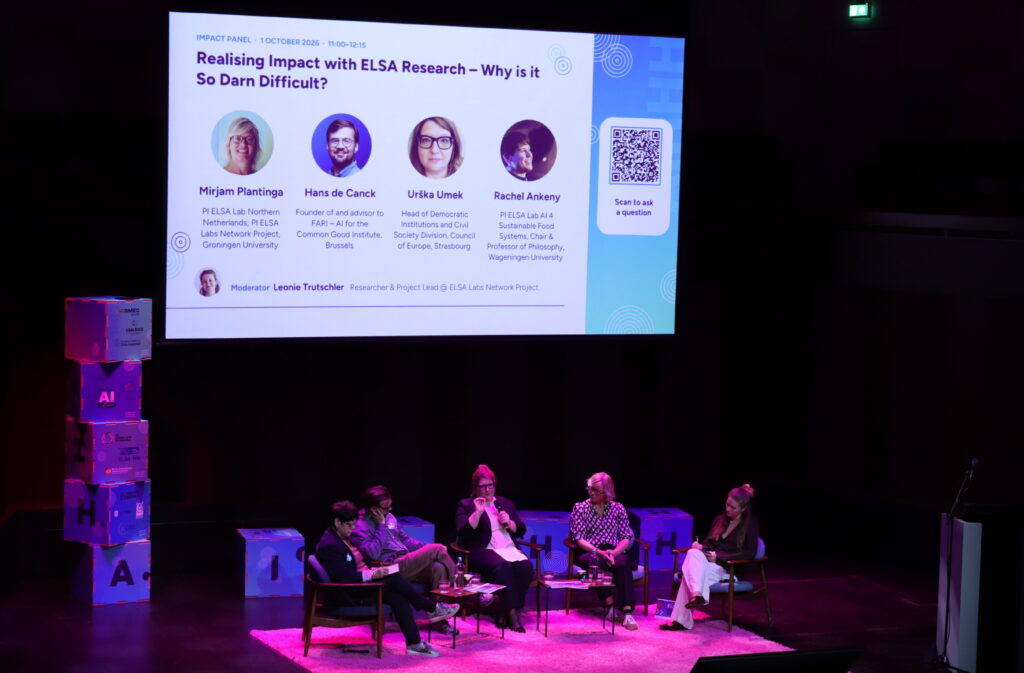
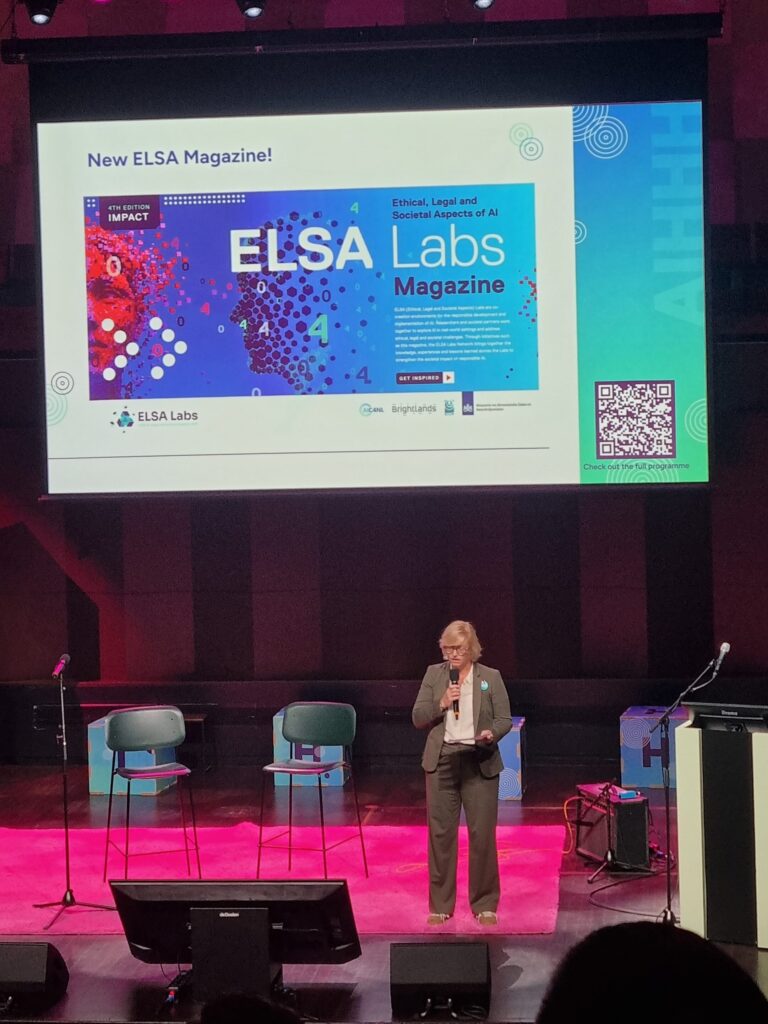
Another panel on the program was “Realising Impact with ELSA Research”, to which we were pleased to invite Urška Umek, the Head of the Media Unit and Democratic Institutions and Civil Society Division within the Information Society Department at the Council of Europe. The discussion explored the same theme as this year’s 4th edition of the ELSA Labs Magazine, which was also released during the festival. Following impact pathways through and ensuring research conducted under the ELSA philosophy meaningfully reaches the involved stakeholders remains a priority for all labs in our network.
Further, many of our members showcased the latest research they have been working on that tackles the use of AI in elections and in news, personalized recommender algorithms, and the representation of civil society in policymaking processes related to digital technology. See a summary below, alongside the posters that were showcased.
Posters:
- Nicolas Mattis, Sophie Morosoli, Laurens Naudts, Natali Helberger and Claes de Vreese (2026). A World of Difference? Key Predictors of Attitudes Towards AI in News Across Six Culturally and Geographically Diverse Countries | See poster
This study explores data from a large survey spanning across Brazil, Denmark, Japan, the Netherlands, the United States, and South Africa interrogating participants’ willingness to engage with AI-generated news, as well as their attitudes towards hyper-personalized news. This data (including additional variables from a related study) can also be explored using this interactive dashboard developed by author Nicolas Mattis. - Sanne Vrijenhoek (2026). Values to Metrics: Co-designing evaluation metrics for a personalized news recommender system | See poster
This poster showcases research conducted by Sanne with Danish newspaper Ekstra Bladet that constituted the basis for developing the newly released Values to Metrics toolkit. Together with many participants from different departments of the news publication, she developed a practical method framework for responsible evaluation metrics. - Philipp Darius (2026). Political alignment of AI for democratic elections: auditing the temporal instability and representational bias of large language models (LLMs) before elections | See poster
As citizens have increasingly been using LLMs for voting advice, it becomes important to interrogate how political parties are represented in the information provided by these systems to identify potential biases. Structured around local elections in Germany, this study audits models from different providers and assesses the accuracy with which they portray party stances.
Talks:
- Gionata Bouché: Editorial autonomy in the age of generative AI: a case study from the Netherlands
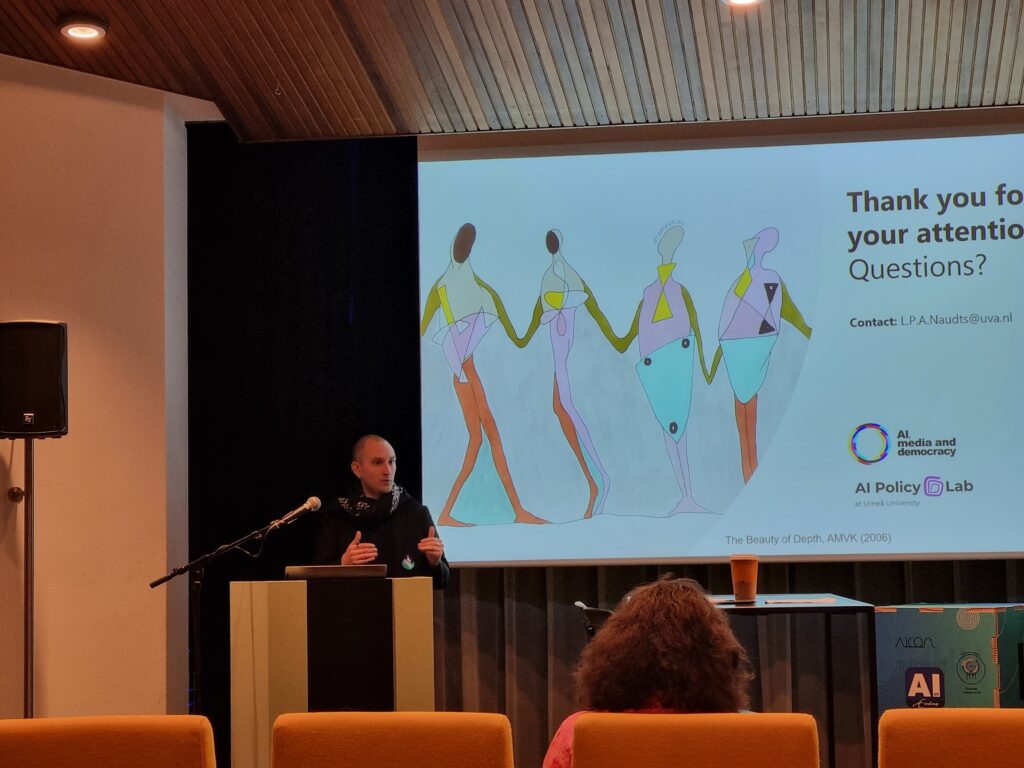
Gionata discussed the results of a forthcoming empirical study conducted at a large Dutch news publisher on the normative boundaries of editorial autonomy with respect to the implementation of generative AI in editorial work. The study finds that although the need for interdepartmental cooperation remains significant, generative AI is a contested object between editorial and non-editorial decision-making. The study also reveals that uncertainty around generative AI’s future prospects stands in the way of drawing these boundaries through internal legally binding mechanisms. - Laurens Naudts: Shaping inclusion: Digital Resistance, Civil Society, and the Politics of (In)Visibility in the EU’s Digital Acquis
This talk, also based on a forthcoming study, discussed the political positioning of civil society organizations in the European Union’s policymaking strategy, especially with regards to their participation in debates about artificial intelligence. Citizen voices are subjected to institutionalization and datafication, and grappling with the consequences of these processes will require negotiation and development of alternative, community-led infrastructures.

Overall, the festival was for us a great opportunity to combine a regular avenue for exchanging findings and research ideas with an occasion for closer engagement with industry and society. We’d like to thank everyone who joined not only our members’ activities, but also all the workshops, demos, and everything else the program had to offer!
